The 0.99 vs 1.00ct jump: why magic carat sizes still print money
A stone that crosses 1.00ct is not just 0.01ct heavier - it lands in a different price tier. Here is why the magic-size premium is still real in 2026.
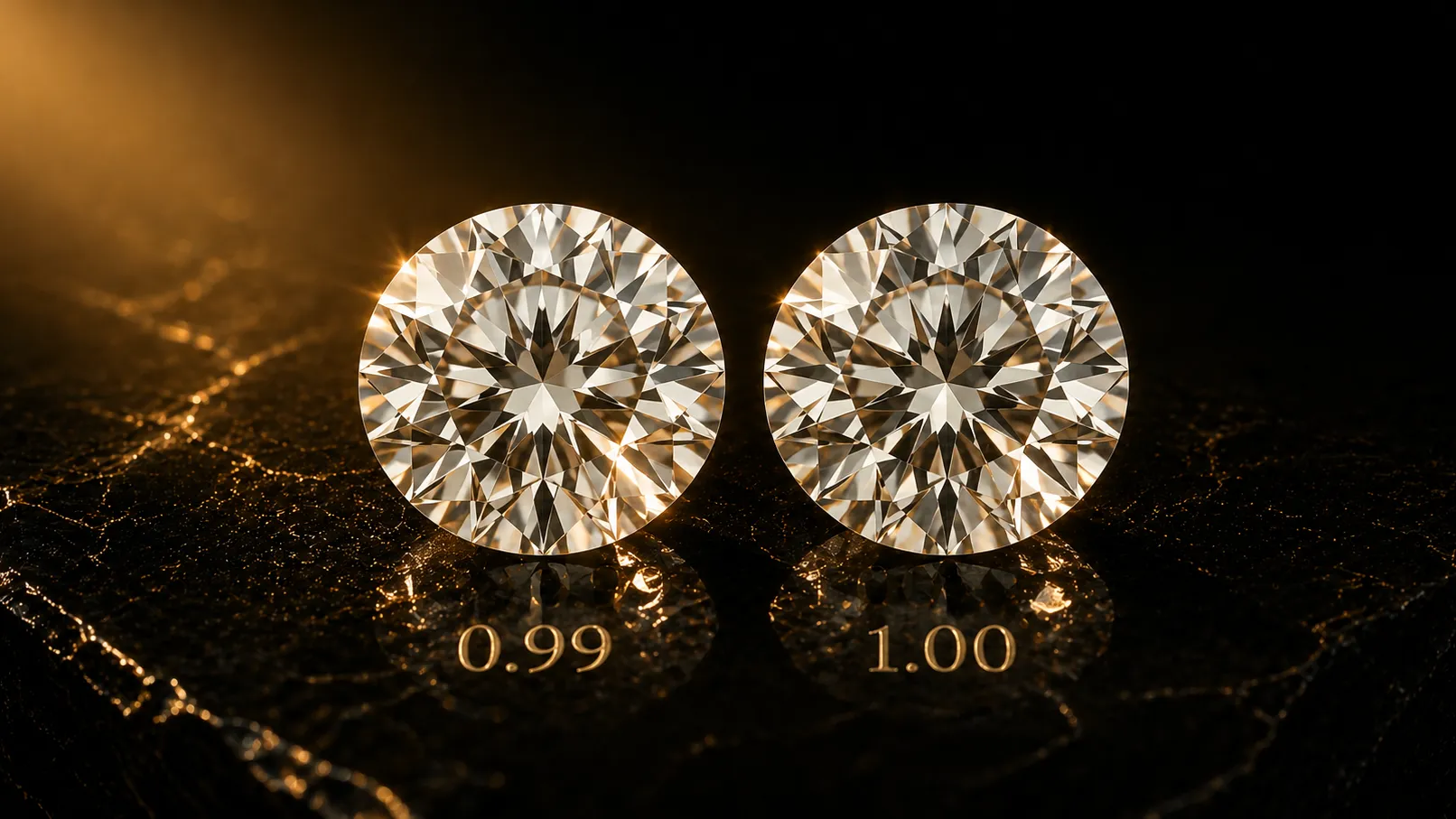
The trade calls them magic carat sizes for a reason. A 0.99ct round brilliant and a 1.00ct round brilliant look identical face-up - about a third of a millimetre difference in diameter - but they trade in different price tiers, and the gap between them has not narrowed in 2026 the way buyer-side voices keep predicting.
The 1 carat price line, in numbers
The standard observation, before any of the segment nuance: a 0.99ct G VS1 EX/EX/EX round on GIA paper trades at a per-carat price 15–25% below an otherwise identical 1.00ct. That is the per-carat figure, not the absolute gap. Stack both the carat count and the per-carat premium step and the absolute spread compounds - a 1.00ct can run 22–28% more expensive than its 0.99ct twin in total dollars.
Weight ratio: 1.01×· Diameter ratio: 1.00×
Diameters use the industry approximation d ≈ 6.5 × ∛(ct) for a well-proportioned round brilliant. Actual cut geometry can shift face-up diameter by a few tenths of a millimetre.
The visual is the part that does not feel reasonable until you remember what the threshold is actually doing. Diameter scales with the cube root of weight, so a 1% weight bump translates to roughly a 0.3% diameter bump - a few hundredths of a millimetre on a round brilliant. The buyer at the counter cannot see the difference. The price sheet can.
Why the gap exists
The threshold premium is a two-sided market effect. On the supply side, rough yield economics push cutters toward 1.00ct as a target weight. A piece of rough that could plan as a 0.99ct with Excellent symmetry, or as a 1.00ct with Very Good, almost always plans as the 1.00ct - the price premium more than compensates for the half-step drop in cut grade. The 0.99ct stones that show up on the market are usually the residue: stones that fell short during polishing or were recut from damaged 1.0x parcels.
On the demand side, the bridal market anchors retail price points at round-number carats. A jeweller's window quotes "1.00ct from $X" because that is the figure shoppers search for. The 0.99ct is rarely advertised; when it is, it is positioned as a value alternative, which pulls the per-carat into the tier below. Both effects compound - cutters aim at 1.00ct, retailers advertise 1.00ct, and the residual 0.90–0.99ct band trades into a buyer pool that knows it is paying below the line.
For the underlying weight-to-diameter math and the yield economics of cutting toward a target weight, Carat walks through the geometry.
Magic carat sizes beyond 1.00ct
The 1.00ct boundary is the loudest threshold but not the only one. Each magic size is a step on the same ladder, with smaller steps as you move away from the bridal centre.
0.50ct- the first retail milestone; per-carat steps up roughly 5–10% versus0.49ct0.70ct- softer threshold, more visible in Asian markets than US bridal; 5–8% step0.90ct- pre-magic-size band; trades 8–15% below 1.00ct on a per-carat basis1.00ct- the dominant threshold; 15–25% per-carat step from0.99ct1.50ct- second-largest jump; 10–15% step from1.49ct, anchored by upgrade-purchase psychology2.00ct- strong retail visibility; 10–20% step, with an extra premium for the round-number marketing line3.00ct- investment threshold; per-carat steps vary widely by colour and clarity but the line is always there
The pattern is consistent across labs and segments. What changes is the size of the step, which reflects how much of each band's demand sits in bridal versus collector or investment buying.
Reading it at the quote
The actionable rule for sourcing or pricing near a carat threshold is simple. When a stone sits in the band immediately below a magic size - 0.96–0.99, 1.45–1.49, 1.95–1.99 - price it against the comparable set that ends before the threshold, not the one that crosses it. Averaging across the boundary blends two markets that buyers do not blend. The same applies in reverse for stones just above: a 1.00ct should pull comps from the 1.00–1.09 bucket, not the 0.95–1.05 spread.
The platform segments price-per-carat data by weight bucket precisely so the boundaries do not get smoothed away. For the broader picture of how weight, colour, clarity and cut combine into a quoted price, What affects diamond price covers the full framework. For the live picture of where these thresholds sit in 2026, see Diamond price per carat in 2026: how the curve actually steps; for the month-end reading on how the 1.00ct step held through April's bridal-band trim, see April 2026 diamond market report: lab-grown gap widens at the top. The magic sizes are one input among several - but they are the input most likely to surprise a quote that ignored them.