Lab-grown market share in 2026: the quiet inflection
Lab-grown now moves more bridal carats than natural in some segments. The dollar share tells a different story - here is what to price against.
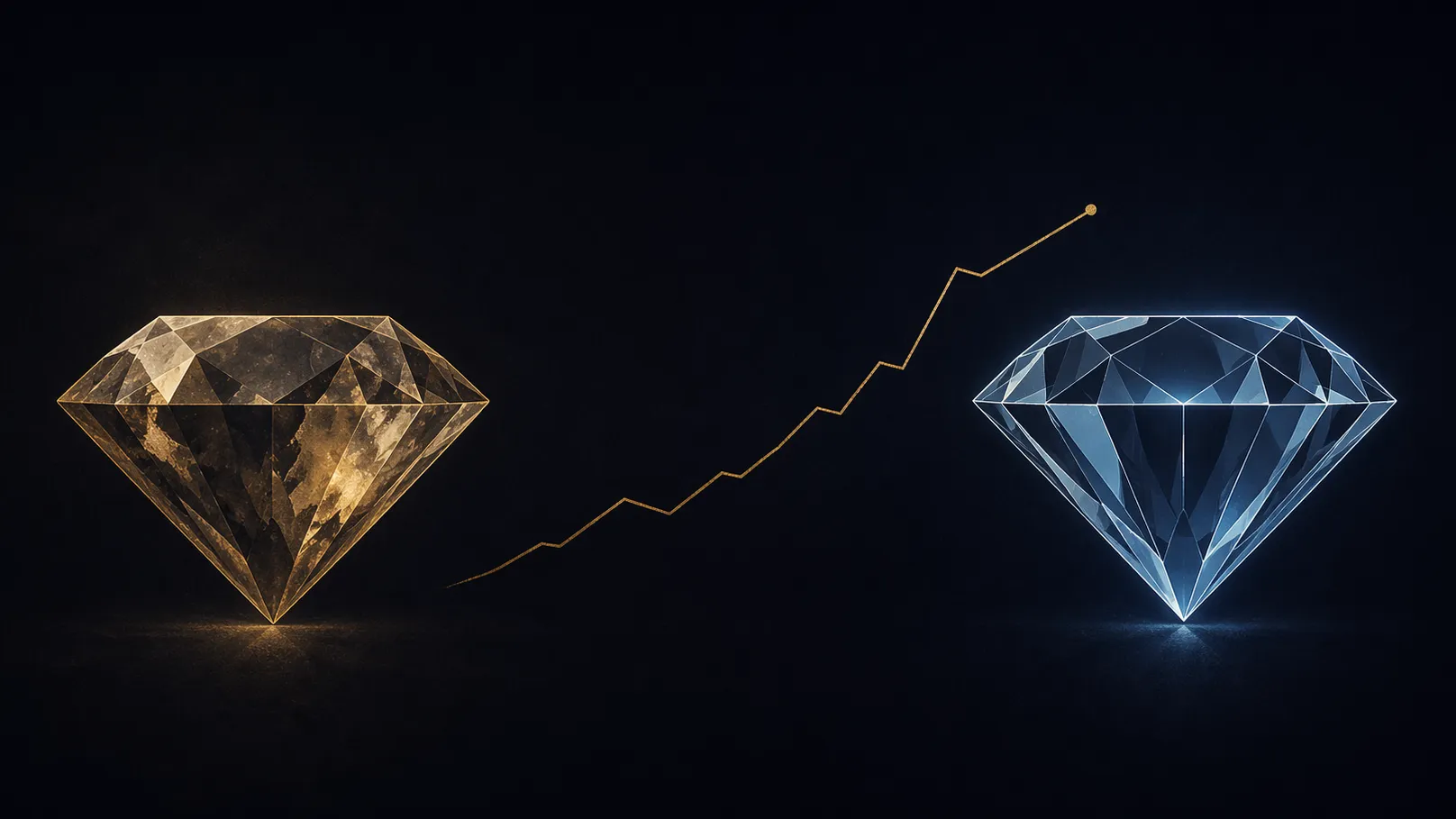
Lab-grown crossed the point where "alternative segment" stopped being accurate sometime in 2025. What replaced it is not a single number but three - unit share, carat share, and dollar share - that now tell three different stories about the same market. Reading them as one aggregate is the fastest way to misquote a stone in 2026.
The share numbers that actually matter
Every market-share chart you see is answering a different question. A lab-grown unit share of roughly half the US bridal market - the figure that made the trade press in late 2025 - counts certificates, not value. Move to carat share and the picture tightens, because lab-grown stones average smaller at retail and the gap narrows to the high-thirties percent range. Move again to dollar share and natural still holds the majority of trade value, because the average price per carat on a natural 1.00ct G VS1 is a different number from the same spec on a lab-grown stone.
The three metrics diverge for a mechanical reason. Lab-grown carries more units through the 0.30–1.50ct bridal band; natural carries more dollars through the >1.5ct, higher-colour, higher-clarity tiers. A trader pricing a single stone only ever sees one of these segments at a time. Using an aggregate share figure to calibrate against is the equivalent of pricing a round brilliant off a cushion benchmark - close enough to look right, wrong enough to miss.
Where natural still holds the spread
The segments natural owns in 2026 are narrower than they were in 2023, but the spread inside them has widened rather than compressed. A natural 3.00ct D VVS1 EX/EX/EX on a GIA report sits in a buyer universe that has barely overlapped with lab-grown at any point. Investment-grade parcels, fancy yellows above Fancy Intense, and fancy pinks all trade with provenance premiums that lab-grown has not priced into. The buyer here is not choosing between the two - they are choosing between this stone and a different natural, or between this stone and another asset class entirely.
The common thread across the natural-dominant segments is thin supply meeting a buyer pool that will pay for it. Signet-grade stones for chain retail, estate parcels with decades of ownership history, and any stone where the GIA report itself is part of the resale story are the areas where the lab-grown discount conversation never starts.
Where the compression is happening
The bridal 1.00–2.00ct band in G–I VS1–SI1 is the zone that defines 2026. Lab-grown production quality in this spec has closed fast - cut grades on IGI and GIA lab-grown certificates now concentrate heavily in Excellent, and the clarity distribution tightened over 2025 as CVD growers optimised for grade yield. A buyer walking into a retail jeweller in this band sees two stones that look, measure, and grade almost identically, with one priced 70–80% below the other.
The compression shows up on the natural side as a grinding price erosion - not a crash but a quarterly trim. Over the 18 months through early 2026, natural prices in this bridal band have shed roughly 15–25% depending on the exact spec, with steeper declines on the I/J colour and SI2 clarity edges where lab-grown competes hardest. Jewellery chains rebalancing inventory mix toward lab-grown accelerate it; the shift in advertised price points in their windows is the leading indicator a wholesale trader sees first.
Reading it at the quote
Treat the lab-grown comp the way the previous post treated the grading lab - as an input to the quote, not a separate universe. A natural 1.10ct H VS2 priced in isolation against a generic natural benchmark will quote 10–20% high in 2026, because the benchmark absorbs segments where lab-grown pressure has already landed but the averaging lags. Pulling the paired comp gives you the resale floor in that spec.
The corollary applies the other direction for stones outside the compression zone. A natural 2.50ct F VVS1 priced against a benchmark that also averages the bridal band quotes low, because the averaging pulls the figure toward a segment this stone does not compete in. The fix is the same - price each segment against its own comparable set, and ignore the aggregate share and aggregate price figures as anything more than context. For the field-level reading of what the grade actually means inside that comparable set, Certification & Lab Grading and Natural vs Lab-Grown Diamonds cover the reference material.
What the next quarter probably shows
Two things are likely to show up in Q2 2026 data. The first is continued compression in the bridal 1.00–2.00ct band - the pattern has been steady for six quarters and no supply-side catalyst looks ready to reverse it. The second is a tentative floor forming on natural in that same band, set by the point at which lab-grown producers hit their own cost floor and can no longer discount further. Where that floor lands is the question the trade is actually pricing around.
Outside the compression zone, expect the spread on investment-grade natural to hold or widen. The share shift is a compositional effect, not a uniform collapse, and reading it that way - segment by segment, metric by metric - is how the quote stays right as the aggregate numbers keep moving.