Lab-grown diamond prices in June 2026: the segments still falling
Lab-grown diamond prices keep sliding into June 2026, but not evenly. Here is the segment-by-segment read on what is still falling and what to price against.
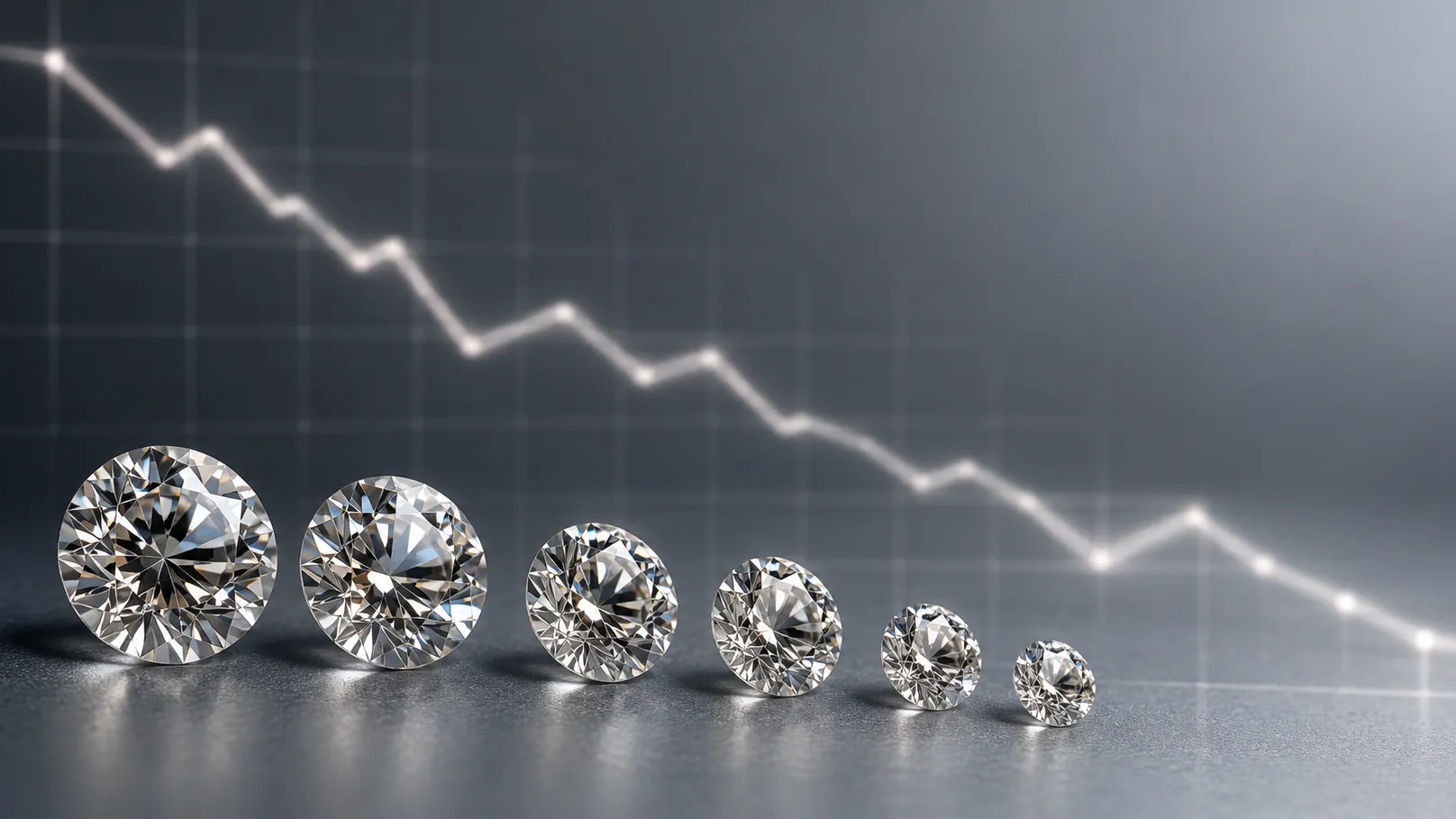
Lab-grown diamond prices did not bottom out in June 2026 — they kept sliding, but only in some segments. The early-June read shows the fall concentrated in the larger weights and the commercial-grade middle, while the smallest melee-adjacent sizes have flattened against a floor that production cost has not yet pushed through. The headline "lab-grown is down again" is true and useless to a desk; the question that prices a stone is which lab-grown, at what weight, on whose comp. Below is the segment read for June, and the part of it a reprice has to act on.
The June 2026 lab-grown price read
June 2026 — lab-grown vs natural, fixed comp
The three tiles fix the June reading against the comparison market that actually frames it. The first two read lab-grown average €/ct as a percentage of the natural comparable on the same fixed spec — round, G VS1, Excellent cut, GIA paper — at 1.00ct and at 2.00ct. The ratio is lower at 2.00ct than at 1.00ct, and that gap between the two tiles is the whole story of where lab-grown is still falling: the larger the stone, the cheaper lab-grown reads against its natural counterpart, and the further it has moved since spring. The third tile is the 30-day move in lab-grown €/ct on the bridal 1.00–2.00ct band — the leading number a desk should carry from one quote cycle to the next, and it still prints negative in June.
This is the same two-market structure the May lab-grown gap read traced from the natural side. There the question was where natural holds its premium; here it is the mirror image — where the lab-grown comparable keeps cutting the floor out from under that premium, and where it has stopped. A trader prices one segment at a time and never the blended figure. The 1.10ct H VS2 lab-grown stone and the 2.50ct E VVS1 lab-grown stone are not on the same trajectory in June, and the desk that reads them off one "lab-grown index" number quotes both wrong.
Which segments are still falling fastest
The fall is not uniform, and the table below ranks the segments by how fast each is dropping, not by where each sits today. The 30-day column is the live signal; the 90-day column shows whether the move is fresh or a continuation from spring.
| Segment | Lab-grown €/ct | 30-day Δ | 90-day Δ |
|---|---|---|---|
| 1.50–1.99ct G–I VS1–SI1 | €637 | -3.6% | 46.9% |
| 2.00–2.99ct G–I VS1–SI1 | €743 | 18.6% | — |
| >=3.00ct G–I VS1–SI1 | €995 | 49.2% | 35.4% |
Two patterns to read. The fastest fall is in the larger commercial weights — 2.00ct and up in G–I VS1–SI1 — where lab-grown supply has scaled hardest and the per-carat line keeps stepping down as growers push bigger rough through the same furnaces at a falling unit cost. The slowest movers are the sub-0.50ct rounds, where the per-carat figure has nearly flattened; the price there is close enough to the cost of cutting and certifying that there is little air left to let out. The bridal 1.00–1.49ct band sits between the two, still trimming month over month but at a slower pace than the larger weights above it.
The 90-day column is the one that reframes the trend. Segments where the 90-day drop is much steeper than the 30-day drop are decelerating — the bulk of the fall is already behind them. Segments where the two columns are close are still mid-move. For a reprice, those are different instructions: the decelerating rows tolerate a longer cycle, while the rows where 30-day and 90-day track together need the next update sooner rather than later.
Why replacement cost matters more than retail price
The reason lab-grown keeps falling where natural holds is that the two are priced off different anchors. A natural stone is priced against a scarce, non-replenishable supply — the comp set is other natural stones of the same spec, and that pool does not grow. A lab-grown stone is priced against its replacement cost: what it costs a grower to make the same stone today. When the cost of growing, cutting, and certifying a 2.00ct G VS1 falls, every existing 2.00ct G VS1 in inventory is repriced downward by the market whether the holder likes it or not, because a buyer can source a fresh one for less.
This is why the retail sticker is the wrong number for a desk to watch. Retail margins on lab-grown have widened as wholesale fell — the shop price moves slowly while the wholesale comp slides underneath it — and a dealer who anchors to the visible retail figure is quoting against a number that has already decoupled from what the stone will actually transact at. The chart below tracks the wholesale per-carat line across the platform's snapshot window, where the replacement-cost slide is visible directly.
Lab-grown avg price per carat by weight band
Round brilliant, G–I VS1–SI1, Excellent cut, GIA — Mar to Jun 2026
The shape is the point: a stepped descent across the weight bands, steepest on the larger series, with the lower-weight line flattening as it approaches its production floor. This is the supply-side mechanic the 2026 market-share inflection described from the volume side — lab-grown taking carat share while its dollar share lags, precisely because the per-carat price keeps falling as the volume climbs. The desk consequence is that a lab-grown stone bought three months ago and not repriced is carried above its own replacement cost, and the longer it sits unrepriced, the wider that drift.
What to watch before the next reprice
The actionable read for June is narrow: pull the live lab-grown comp on every stone in the larger commercial weights before quoting, and treat the 30-day move as the live input rather than the standing benchmark. The smaller rounds, near their floor, tolerate a slower cadence — a context check, not a fresh pull each cycle. The split in the table is the cadence map: the rows where 30-day and 90-day track together want the weekly read; the decelerating rows do not.
The fall will keep concentrating in the weights where production is still scaling, and the floor on the smallest sizes will hold until cutting and certification cost moves, which it has not. What a desk should not do is wait for a single "lab-grown bottom" to call — there is no one bottom, only a set of segment floors landing at different times. The book that reads each segment against its own replacement-cost comp, and reprices the still-falling rows on the shortest cycle it can run, is the one that will not be carrying June's larger stones at March's prices when the next snapshot lands.