GIA certificate pricing: how much does the report change the quote?
The same stone quotes differently on GIA versus IGI paper. Here is how much the certificate moves a diamond's price, and how to read it before you quote.
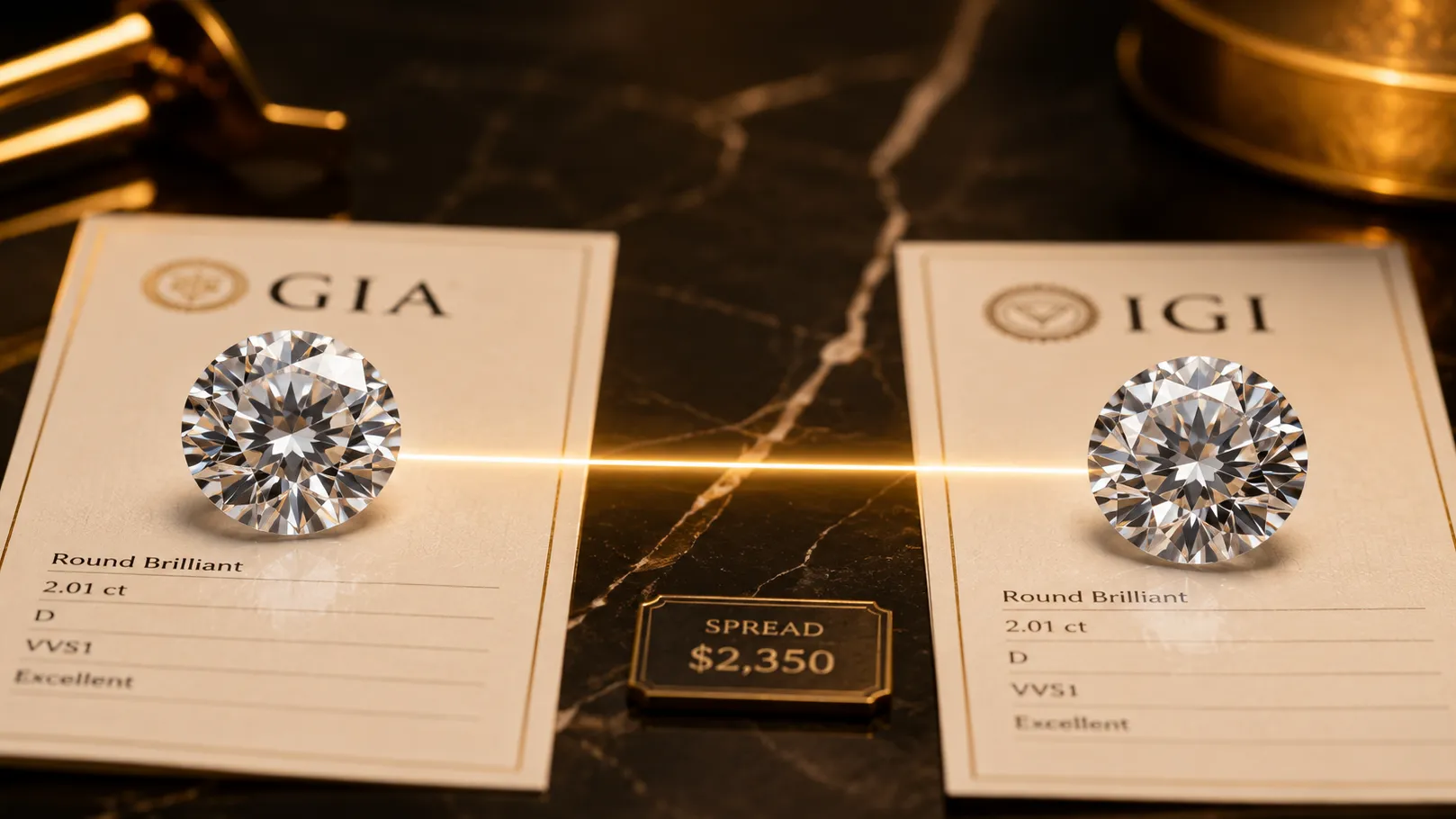
Put two physically identical round brilliants on a desk — same 1.00ct, same G VS1, same Excellent cut — and quote them. If one carries a GIA report and the other an IGI report, the two numbers will not match. The certificate is not paperwork that trails the price; it is an input to the price. The question a desk actually has to answer when a stone arrives is not "what is this stone worth" but "what is this stone worth on this report," and the gap between those two questions is where quoting mistakes live.
Why the certificate changes the comparable set
A grading report does two jobs. The obvious one is describing the stone — the 4 Cs, the measurements, the fluorescence. The one that moves price is quieter: the report decides which pool of stones yours is compared against. A 1.00ct G VS1 EX on GIA paper is priced against other GIA stones of that spec — a buyer universe that trusts the printed grade and has a clean resale path. The same physical stone on IGI paper is priced against IGI comps, a different pool that carries its own discount. The comparable set is selected by the lab name at the top of the page, not by the stone in the tweezers.
That is why the certificate changes the quote even when the grades are word-for-word the same. Two stones can read G VS1 EX and still sit in two different markets, because a buyer sourcing sight-unseen is buying the paper as much as the stone. There is also grade-drift risk to price: a report graded generously in one lab may regrade lower elsewhere, and the market discounts that risk per lab rather than per stone. None of this is visible under a loupe. It is visible only in the comparable set the report points at, which is exactly what Price a Diamond by Certificate resolves when you enter a report number.
The report fields do their own work on the comp set. A missing cut grade on a fancy shape, an absent fluorescence-colour note on a blue-fluor D–F stone — each one narrows what you can safely compare against and forces a more conservative quote. For the structure of what a certificate contains and why the issuing lab became a price determinant in its own right, see Certification & Lab Grading.
GIA vs IGI pricing is a market signal, not a grading argument
The trade spends a lot of breath on which lab grades more strictly. For pricing, that argument is beside the point. The spread between the two labs on the same spec is the signal, and it points in opposite directions depending on the stone. On natural diamonds, a GIA report anchors the premium tier — a G VS1 round trades tighter to high bid on GIA paper because the buyer universe is larger and the resale path is cleaner. On lab-grown, the picture inverts: IGI carries the volume, while a GIA lab-grown report earns a small upcharge from buyers who need GIA on the final invoice.
The table below reads that spread as a number, on a fixed comparable, so it is the same stone across the row and only the lab changes.
| Segment | GIA €/ct | IGI €/ct | GIA over IGI |
|---|---|---|---|
| Natural 0.90–0.99ct | €3,346 | €2,695 | 24.2% |
| Natural 1.00–1.49ct | €4,468 | €3,328 | 34.3% |
| Natural 1.50–1.99ct | €7,968 | €5,408 | 47.3% |
| Natural 2.00–2.99ct | €12,522 | €8,224 | 52.3% |
| Lab-grown 2.00–2.99ct | €658 | €327 | 101.3% |
Read the spread column, not the absolute prices. On the natural rows, GIA prints above IGI on the identical spec, and the gap widens in the weights where resale confidence matters most. On the lab-grown rows the two labs sit far closer, and the small GIA premium is the invoice effect, not a grading gap. The chart makes the same point across weight bands, so you can see where the report earns its spread and where it barely moves the number.
Same-spec price by lab, natural rounds
Round brilliant, G VS1, Excellent cut — median €/ct by weight band, June 2026
The shape is the lesson: the lab spread is not a flat percentage you can memorise and apply. It is narrow on some segments and wide on others, and it is the wide segments that punish a desk treating the two reports as interchangeable. This is the same divergence the 2025 grading shift traced through the market — read the lab first, then the grade, then the spread that sits between them. A generic benchmark that averages the two labs into one number quotes every one of these segments slightly wrong.
Certificate-level pricing vs bucket-level fallback
There are two ways to price a stone, and the certificate decides which one you get. With a report number in hand, the platform prices the specific stone against certificate-level comps — the actual lab, the actual printed fields, the actual comparable pool. Without it, pricing falls back to a bucket: an average across a spec band that necessarily blends labs, edge grades, and stones that only resemble yours. The bucket is a fallback, not a failure, but it carries a wider tolerance by design.
The practical consequence is that the bucket is fine for triage and dangerous for commitment. When you are scanning a parcel to decide what is worth a closer look, the bucket read is enough. When you are about to put a number against a supplier's stone, the certificate-level comp is the one that protects the margin — and on a wide-spread segment, the difference between the two is the difference between a fair quote and a loss.
How to use the report before committing to a supplier price
Before you commit a number, pull the certificate-level comp on the stone's actual lab rather than the blended benchmark. Treat missing fields as conservative inputs: a fancy shape with no cut grade quotes down a notch until proven, and a D–F stone with no fluorescence-colour note gets the cautious read. The lab on the report is a sixth C sitting alongside carat, colour, clarity, cut, and fluorescence — price each combination on its own, against real comps in that lab's segment.
The direction of travel is toward deeper certificate-level data, and as that pool fills, the bucket fallback shrinks and the lab spread gets easier to read stone by stone. Until then, the desk edge is simple and unglamorous: quote the report number, not the visible stone. The trader who prices a G VS1 EX off the paper it carries — and off the comparable set that paper points at — collects the spread that the trader pricing the loupe leaves on the table.