Diamond price by shape: the 2026 elongated premium
Marquise, pear and oval now ask above round per carat in the bridal band, while cushion and asscher sit 30% below. The fancy category has split in two.
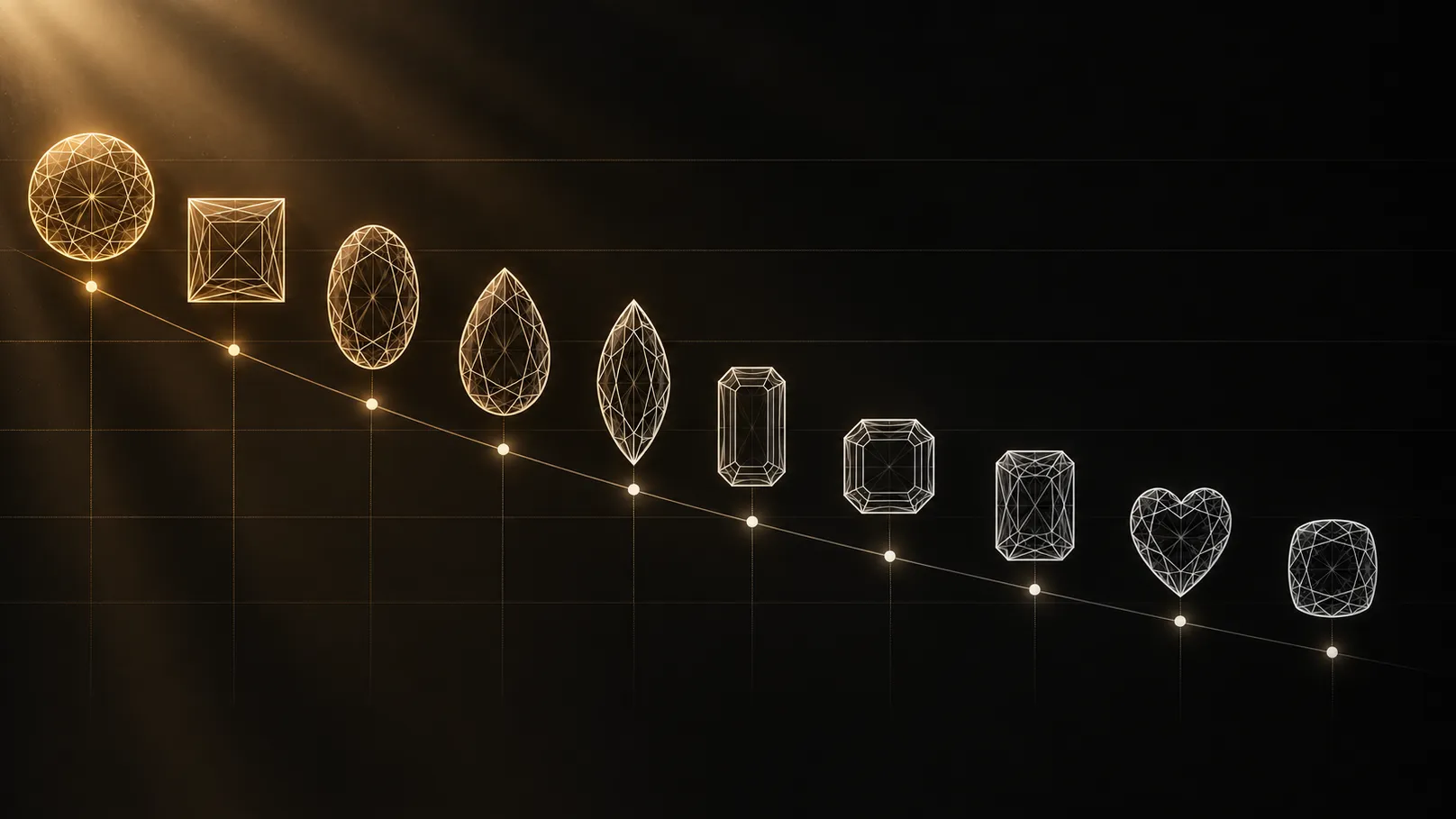
Round brilliants have a price sheet of their own. Every other shape splits one. That arrangement assumed fancies sit below round and differ only in how far below — an assumption the bridal band stopped honouring some time in 2026.
What a price list actually resolves about shape
The Rapaport price list publishes in two parts: a round sheet and a pear sheet, with the pear grid carrying indications for the other common shapes. Both resolve the same four inputs — colour D through M, clarity IF down to I3, weight band, and the shape family the sheet covers — to a per-carat asking figure. The mechanics of reading the grid are the same on either sheet, and the references a desk prices against alongside it cover what a published list leaves out in general. This post takes one dimension of that.
For rounds, the structure holds up. Round brilliant is the deepest, most fungible category in the trade, its cut grade is standardised on every major report, and a 1.00ct G VS1 EX resolves to a comp set large enough that a cell means something. Two desks quoting the same cell are describing the same stone.
For fancies, the same four inputs resolve to a category, not a comparable. An oval, a pear, a marquise, an emerald, and a radiant at 1.00ct H VS2 read off one grid and trade at five different numbers — and asscher, heart, and cushion sit under the same sheet again. The back — the percentage below list a stone actually clears at — is where every one of those differences ends up. That is the failure mode a flat discount to Rap produces once a book carries more than one shape, and in the bridal band it now fails in both directions at once.
Three variables behind the split
Shape pricing goes wrong in a specific place: the certificate fields the grid reads are not the fields the market pays for.
Length-to-width ratio is the first. An oval at 1.35–1.50 and an oval at 1.20 are the same shape, the same weight, and the same grades. They are not the same stone to a buyer, and through 2026 they have not been the same price. Trade reporting this year has put long cushions at a premium over square ones in the 2.00ct+ band, and the same split runs through radiants and emeralds. Ratio appears on the report as measurements. It appears on the grid nowhere.
Spread is the second, and it is the one doing most of the work below. Fancy shapes distribute weight differently, so face-up size per carat varies by shape and by cut depth within a shape. At equal weight a marquise faces up roughly 15% larger than a round and an oval about 10% larger, while a princess reads about 15% smaller and an asscher smaller still. A retail buyer is paying for the millimetres they can see, and per-carat pricing charges for weight they cannot.
Cut performance is the third, and it is the one with no grade at all — for now. GIA issues a cut grade for round brilliants only. On a fancy, Excellent polish and symmetry describe finish quality, not light return: a bow-tie, a crushed-ice pattern, or a windowed table sits entirely outside what the report grades. Two 1.20ct pears with identical paper can be a fast stone and a stone that ages on the shelf.
That gap has a closing date. GIA announced in June 2026 that it will launch cut grading for marquise, oval, and pear from 2027, with the launch detail due early that year. Those are the three shapes at the top of the table below — the ones carrying a premium today are the ones about to become gradeable, which means the fancy market is roughly a year from its first paper-visible quality axis. Stones bought on hand inspection today get re-read against a grade later, and the goods that grade poorly are the ones a desk is currently free to describe as Excellent finish.
| Shape | Median €/ct | vs round | Stones |
|---|---|---|---|
| Marquise | €4,160 | 20.6% | 82 |
| Pear | €4,070 | 18.0% | 341 |
| Oval | €3,660 | 6.2% | 581 |
| Round | €3,448 | 0.0% | 2,062 |
| Radiant | €3,381 | -1.9% | 245 |
| Emerald | €3,207 | -7.0% | 402 |
| Princess | €2,977 | -13.7% | 383 |
| Heart | €2,648 | -23.2% | 232 |
| Cushion | €2,281 | -33.8% | 481 |
| Asscher | €2,173 | -37.0% | 122 |
The category has split. Marquise, pear, and oval ask above round per carat at this spec; cushion and asscher sit a third below it. A single fancy back does not merely lose precision across that range — at the top of the table it carries the wrong sign, and a desk applying one is discounting stones the market is currently asking a premium for.
Two things the table is not. These are asking prices, not closed trades, and asking runs furthest ahead of closing exactly where supply is tight, which is where the elongated goods are. And the ordering is band-specific: the same comparable at 1.50–1.99ct put pear at -1.7% and oval at -11.5%. The premium lives in the bridal band, not across the market.
There is also a unit problem hiding in the column. Per-carat pricing charges by weight, and the shapes at the top of the table are the ones that convert weight into face-up size most efficiently. Rescaling each figure by the typical face-up index for its shape — approximations from standard proportions, not measurements of these stones — the premium mostly evaporates: marquise moves from about +21% to +5%, oval from +6% to roughly -3%, while emerald slips from -7% to about -16% and cushion holds near -29%. Per carat the elongated shapes look expensive. Per visible millimetre they are close to parity, and the deep discounts stay deep.
Where fancy demand actually sits going into Q4
The 2026 pattern is polarisation, not a general fancy rally, and the table is what polarisation looks like priced. Elongated goods — ovals in the 1.35–1.50 ratio band, long radiants, emeralds, long cushions — have been carrying demand, with the US market the deepest buyer of elongated ovals and European desks running closer to the historical shape mix. Marquise in particular has been reported in short supply in the higher grades all year, which is consistent with a spec asking +21% on the thinnest stone count in the table.
Per-carat price by shape, against round
Natural, H VS2, 1.00–1.49ct, GIA — median €/ct relative to round brilliant
Two things follow for a desk restocking into the holiday season. The first is that shape-level demand moves faster than grade-level demand, because it is driven by consumer preference rather than by supply of rough at a spec. A shape back set in spring describes a market that has since inverted at one end. The second is that the shapes clearing fastest are defined by a field the price list does not carry, so a purchase filter written in grades will buy the wrong half of the category.
One more dated change lands inside the same quarter. From Q4 2026, GIA adds comments to D–Z reports noting whether fluorescence may improve or degrade a stone's appearance under UV-rich light — on roughly one in ten of the natural stones it grades. That moves a second unpriced trait onto paper, on the same stones being bought for the holiday season now.
Common questions about diamond price by shape
Which diamond shape is most expensive per carat?
Historically round brilliant, and for a structural reason: a round yields only about 40–43% of the rough crystal it is cut from, against 60–65% for a princess and 60–70% for an emerald, and it holds the deepest retail demand. In the bridal band in 2026 that has stopped being true at the top. At 1.00–1.49ct H VS2 GIA, marquise asks about 21% above round per carat and pear about 18% above, on samples of 82 and 341 stones. Rough yield still sets the floor; current demand is setting the ceiling somewhere else.
How much cheaper are fancy shapes than rounds?
Some are not cheaper at all any more. At one fixed bridal spec the range runs from roughly +21% above round to -37% below it, and three of the ten commercial shapes sit on the premium side. The deep end is cushion and asscher at around -34% and -37%; the middle is emerald and princess in the -7% to -14% band. Quoting a single fancy back across that spread misprices both ends, and at the top it misprices the direction as well.
Why do two ovals with the same certificate trade at different prices?
Because the fields that separate them are not graded. Length-to-width ratio, face-up spread, and light performance all move a fancy's price, and none of the three carries a grade on the report the way a round's cut does. Identical paper, different stones — until the 2027 cut grade covers ovals, at which point one of the three moves onto the certificate.
Should fancy shapes be priced off the Rapaport pear sheet?
For structure, yes — it gives a shared vocabulary and a weight-and-grade skeleton. For level, only with a per-shape back, and in the bridal band that back is no longer reliably a discount. The sheet resolves a category; the market prices a shape.
Does the shape premium apply to lab-grown diamonds?
The direction holds and the magnitude does not. Lab-grown comps reset against production cost rather than rough scarcity, so the round-versus-fancy structure that scarcity creates is compressed. Fancy backs there track cutting capacity and demand shifts on a faster clock, as the June segment read showed band by band.
Pricing shape as a variable, not a sheet
Shape is not a lookup, and treating it as one puts a category-level number on a stone-level decision. The reference under a fancy quote has to be a comp set for that shape, that ratio band, and that weight — not the grid the shape happens to share with nine others. Stone Insights derives the comp set per segment for exactly that reason, so the figure under a quote is current for the band being quoted rather than a category average typed in last quarter.
Measuring the exposure takes one pass, and the sort order is the whole trick. Export the fancy portion of the book, price every row against a per-shape comp set with Batch pricing with CSV, then group the disagreements by shape before reading them. In aggregate the errors net to roughly zero and the book looks correctly priced. Split by shape, the same rows show which half of the category is subsidising the other. Price by parameters covers the stones with no certificate to read from, which on a fancy book is rarely a small share.