VS1 vs VS2 clarity: the price gap that keeps shrinking
VS1 vs VS2 used to print a clean 5–8% per-carat premium. In 2026 that spread is flattening across the bridal band - here's where it's still real.
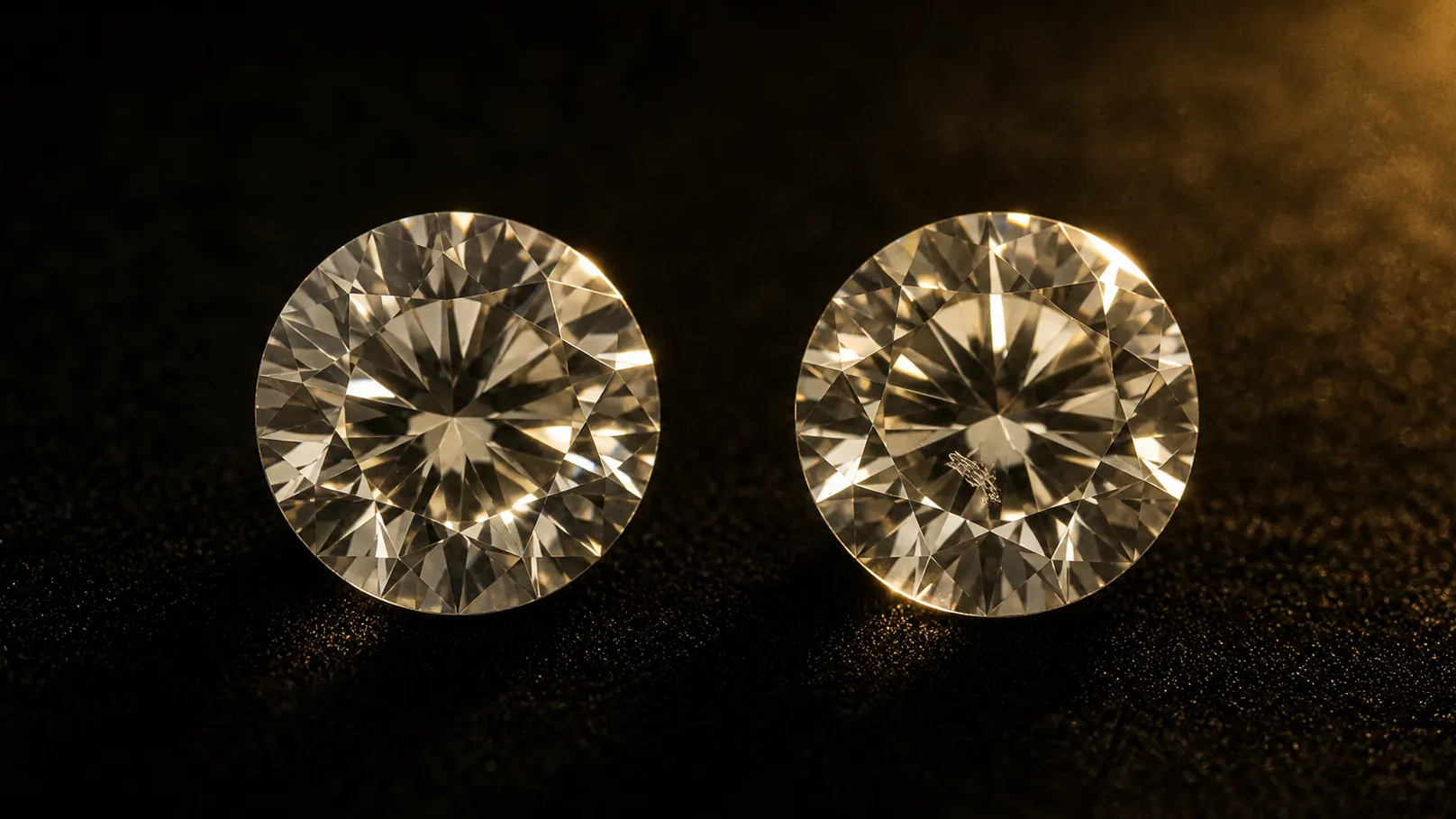
Both VS1 and VS2 are defined as eye-clean in commercial sizes - neither shows inclusions to the naked eye in the 0.30–3.00ct band that covers the bulk of bridal and retail trade. The trade has still paid 5–8% more for the higher grade through most of the last decade, on the working assumption that the printed letter would carry into resale. In 2026 that assumption has loosened, and the spread between the two grades is flattening across most of the bridal weight band.
What VS1 and VS2 actually mean
Clarity is graded under 10× magnification on an 11-step ladder running from FL to I3. The VS band - very slightly included - sits two steps below flawless and splits into two grades. VS1 carries small inclusions that take effort to locate at 10×; VS2 carries the same kinds of features but slightly more of them, or one in a position the grader noted. Both are reliably eye-clean in commercial round-brilliant sizes. Neither is visible to a buyer holding the stone at arm's length.
Eye-clean:yes·Eye-clean face-up; inclusions only under 10×
Inclusion positions, counts, and types are schematic — each real stone has its own unique plot. The toggle switches between unaided face-up observation and laboratory-standard 10× loupe magnification.
The viewer toggles between naked-eye and 10× loupe perspectives. Switching the grade between VS1 and VS2 shows the kind of feature delta that a lab grader records - small enough that the unaided eye reads both stones as identical, large enough that a 10× loupe cleanly distinguishes them.
The spread, by the numbers
Through the 2018–2023 window, the per-carat premium for VS1 over VS2 on otherwise-identical round brilliants ran 5–8% in the bridal band and tightened to 3–5% above 2.00ct. The figure was stable enough that wholesale price sheets carried it as a fixed step. Through 2024 and into early 2026, that step has compressed to 2–4% in the bridal band and now reads close to flat in segments where lab-grown competition is heaviest.
The live reading below fixes the comparable to natural round brilliant, color G, Excellent cut, on GIA paper, varied only by clarity between VS1 and VS2. Prices are observed listing prices in EUR aggregated across the platform's source pool, snapshot to the most recent month. Holding the rest of the spec still is the only way to read the clarity step cleanly - letting colour or cut drift across the rows blends two effects into one number that describes neither.
| Weight band | VS1 median €/ct | VS2 median €/ct | VS1 over VS2 | Sample |
|---|---|---|---|---|
| 0.50–0.69 | €1,678 | €1,566 | 7.2% | 21,410 |
| 0.90–1.09 | €4,241 | €3,756 | 12.9% | 10,241 |
| 1.50–1.99 | €8,231 | €7,667 | 7.4% | 3,189 |
| 2.00–2.49 | €14,680 | €13,214 | 11.1% | 1,117 |
| 2.50–2.99 | €17,239 | €15,958 | 8.0% | 561 |
| 3.00–3.99 | €24,559 | €19,880 | 23.5% | 397 |
| 4.00+ | €37,847 | €33,620 | 12.6% | 237 |
The pattern across weight bands is consistent: the headline premium has not vanished, but it has compressed enough that averaging across the two grades - which a lot of trade quoting tools still do - now lands closer to either grade's true price than it did three years ago.
| 2018–2023 typical | 2026 reading | Direction | |
|---|---|---|---|
| `0.50–0.69ct G EX` | 6–8% | 2–4% | Compressed hard |
| `0.90–1.09ct G EX` | 5–7% | 2–3% | Compressed hard |
| `1.50–1.99ct G EX` | 4–6% | 3–5% | Compressed lightly |
| `2.00–2.99ct D EX` | 3–5% | 3–5% | Held |
| `>3.00ct D EX` | 3–4% | 4–6% | Widened |
Two readings stand out. The bridal band has compressed the most, which is consistent with where lab-grown supply has saturated hardest and where buyers are increasingly indifferent between the two VS grades. The >3.00ct D band has moved the other way - the spread has widened, because investment-tier buying has stiffened against VS2 on stones that may resell.
What's compressing it
Three forces are pulling the spread closer to flat in the bridal band. First, lab-grown competition through G–I VS1–SI1 has flooded the segment with stones priced 70–80% below natural at every clarity grade. When a buyer chooses between a lab-grown VS1 and a natural VS2 at similar absolute prices, the natural VS2 wins on natural-vs-lab grounds long before the clarity letter enters the conversation. The compression mechanics across this band are covered in Lab-grown market share in 2026: the quiet inflection.
Second, retail has moved its language. Jeweller windows that quoted "VS-or-better" through the 2010s now quote "eye-clean" as the headline. The replacement is not cosmetic - it tells the shopper that anything from SI1 upward will look identical face-up, which directly undermines the case for paying the VS1 step over a clean VS2. Once the floor of the value proposition moves, the premium step above it loses its anchor.
Third, the clarity plot on a modern certificate is granular enough that a sourcing manager can price the actual inclusion rather than the letter. IGI plotting on lab-grown stones has tightened over 2025, and GIA plots on naturals carry inclusion type, position, and approximate size. A VS2 with a single small feather at the girdle prices closer to a VS1 than to a VS2 with a centred crystal - and traders are reading the plots, not the letters. The lab-by-lab divergence in plotting is the subject of GIA vs IGI: what the 2025 grading shift means for your prices.
Where VS1 still commands a premium
The compression is not uniform. Two pockets are holding their VS1 premium and one is widening it.
Investment-tier parcels above 2.00ct in D–F colour still pay for VS1 because the buyer is pricing for a 10–20 year resale path, not a setting. The certificate letter survives as a category marker even when the inclusion plot does not differentiate the two stones. Fancy shapes - emerald, asscher, and cushion in particular - also hold the spread, because the open table in those cuts makes a VS2 inclusion easier to spot face-up than the same inclusion in a round-brilliant pavilion. The geometry of the cut still matters at the grade boundary.
The widening pocket is >3.00ct D VVS1–VS1 on GIA paper. Buyer pull at the top of the bridal-to-investment crossover has stiffened over 2025, and the spread to VS2 in the same band has opened rather than closed. This is the same dynamic that has widened the 2.00ct carat-step in 2026 - described in Diamond price per carat in 2026: how the curve actually steps - playing out one grade up.
Pricing the grade in 2026
The clean rule has not changed: price each grade against its own comparable set, never the average across the boundary. What has changed is the size of the step you are respecting. A 6% spread is large enough that a misquote on a single bridal stone matters; a 2% spread is inside the noise of how individual sellers position themselves week to week.
For the underlying mechanics of the clarity scale and what each grade band actually contains, Clarity is the reference. For working through the per-grade math on a specific stone, the parameter-based pricing flow at Price a Diamond by Parameters lets you compare the VS1 and VS2 recommendations against the same colour, weight, and cut. The trade has spent a decade pricing the letter; the next decade will price the plot.